

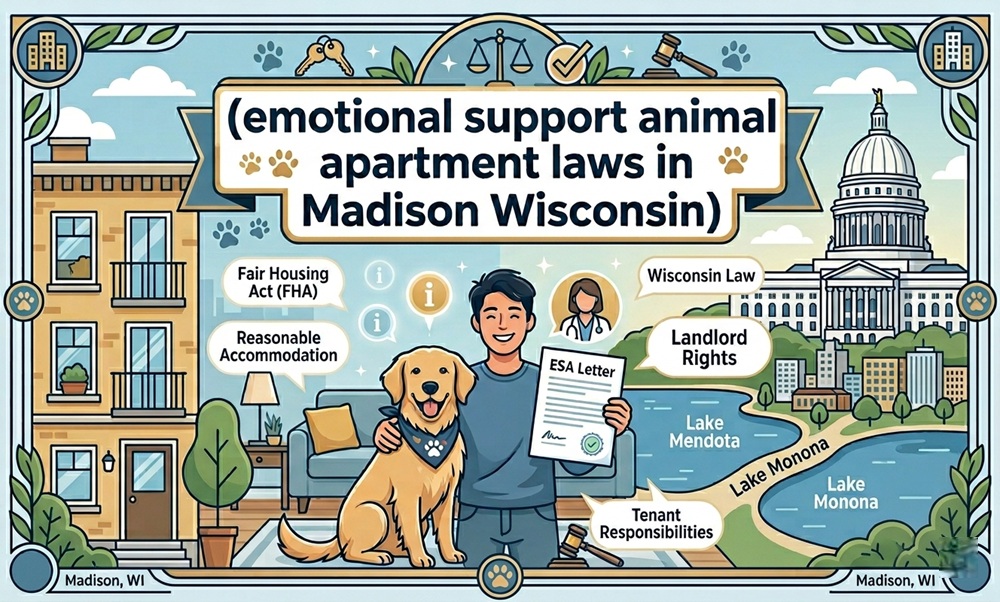
You have an emotional support animal that genuinely helps you manage a mental health condition. But your Madison apartment has a no-pet policy — and your landlord just said no. Are they within their rights?
Probably not. Federal law and Wisconsin fair housing protections give tenants with emotional support animals meaningful rights, even in buildings with strict no-pet policies.
The Federal Law That Protects ESA Owners
The Fair Housing Act (FHA) requires housing providers — including most Madison landlords and property management companies — to make reasonable accommodations for people with disabilities. An emotional support animal is considered a reasonable accommodation, not a pet.
This means a landlord with a no-pet policy must still allow a properly documented ESA in most cases.
What Qualifies as an Emotional Support Animal?
Unlike service animals, ESAs don’t require specialized training. They provide emotional support through companionship for people with recognized mental health conditions such as:
- Anxiety or depression
- PTSD
- Bipolar disorder
- Panic disorder
- Phobias
Any domesticated animal can be an ESA — it doesn’t have to be a dog or cat.
What Your Landlord in Madison Can and Cannot Do
What a Landlord CAN Do:
- Request documentation (a letter from a licensed mental health professional)
- Ask whether the animal is needed due to a disability (but not for specifics of the diagnosis)
- Deny an ESA if the animal poses a direct threat to others or would cause substantial property damage
What a Landlord CANNOT Do:
- Charge a pet deposit or pet fee for an ESA
- Deny housing solely because of a no-pet policy
- Demand to know your specific diagnosis
- Require your ESA to have specialized training or certification
- Use unofficial online “ESA registration” as the basis for acceptance or denial
ESA vs. Service Animal: Quick Comparison
| Feature | ESA | Service Animal |
|---|---|---|
| Needs special training? | No | Yes |
| Covered by Fair Housing Act? | Yes | Yes |
| Allowed in public spaces? | No (only housing) | Yes |
| Documentation required? | Yes (mental health letter) | No |
Getting Your ESA Documentation Right
Your landlord can request a letter from a licensed mental health professional (therapist, psychologist, psychiatrist, or licensed clinical social worker) stating that:
- You have a disability
- You have a disability-related need for an ESA
You are not required to use an online ESA certification website — and many Madison landlords are rightly skeptical of those. A letter from your actual treating provider carries the most weight.
Pro Tips
If your Madison landlord denies your ESA request in writing, file a complaint with HUD (hud.gov) or the Wisconsin Department of Agriculture, Trade and Consumer Protection (DATCP). HUD investigations are free and can result in settlements.
Common Mistakes to Avoid
- Using an online “ESA registration” service instead of a real provider letter
- Assuming a condo HOA or co-op is exempt (most aren’t under the FHA)
- Not making the request in writing — always document your accommodation request
- Waiting until you’re facing eviction to assert your rights
FAQs
Q: Can a Madison landlord refuse my ESA if they’re allergic? A: Allergies alone are generally not sufficient grounds to deny an ESA. The landlord would need to show the accommodation creates an undue hardship.
Q: Does Wisconsin have any state-specific ESA laws? A: Wisconsin follows federal FHA standards. The Wisconsin Fair Housing Law (§ 106.50) aligns with federal protections.
Q: Can my landlord limit the size or breed of my ESA? A: Not based on breed or size alone. Restrictions must be based on the specific animal’s behavior, not assumptions about its type.
Conclusion
In Madison, your right to keep an emotional support animal in a no-pet apartment is protected by federal and state law. Get a legitimate letter from your mental health provider, make your request in writing, and know that your landlord cannot charge you a pet fee for an ESA. If they refuse without legal justification, you have real options — including filing a federal fair housing complaint.
